Αναζήτηση αυτού του ιστολογίου

10 Σεπτεμβρίου, 2020

ΚΩΣΤΑΣ ΕΥΘΥΜΙΑΔΗΣ: Ὁ πρωτοπόρος ἀκτοπλόος πού κατεστράφη ἀπό τό "Ἐλεάννα"


POSTED ON 
 

Στήν ἱστορία τῆς ἀκτοπλοΐας ὁ Κώστας Εὐθυμιάδης ὑπῆρξε ἐξέχουσα μορφή ἐπιχειρηματικῆς τόλμης καί δημιουργίας καί ἒμεινε γνωστός ἐπειδή ἂνοιξε νέους θαλάσσιους δρόμους μεταξύ τῶν νησιῶν, ἀλλά καί μεταξύἙλλάδος καί Ἰταλίας, συνδέοντας τόν Πειραιᾶ μέ τήν Ἀγκώνα,δρομολογῶντας μεγάλα μετακευασμένα τάνκερς σέ ἐπιβατηγά ὀχηματαγωγά.


Ὃταν ἒγινε τό πολύνεκρο ναυάγιο τοῦ "Ἡράκλειον" τῶν ἀδελφῶν Τυπάλδου,πού ἀπασχολοῦσε τό πανελλήνιο ἐπί μῆνες, οἱ Κρητικοί προτιμοῦσαν τά πλοῖα τοῦ Εὐθυμιάδη "Μίνως" καί "Φαιστός" στίς μετακινήσεις τους καί τούς δημιουργήθηκε ἡ ἰδέα νά δημιουργήσουν δική τους ναυτιλιακή ἑταιρία λαϊκῆς βάσεως. Ἡ δικτατορία ἦλθε στά πράγματα λίγο μετά τό ναυάγιο τοῦ Ἡράκλειον". 

Ἡ πρώτη ἑταιρία λαϊκῆς βάσεως ἦταν ἡ ΑΝΕΚ καί ἂρχισε τήν δραστηριότητά της μέ τό "Κύδων", ἀνάδοχος τοῦ ὁποίου ἦταν ὁ Στυλιανός Πατακός.
Ὁ Κώστας Εὐθυμιάδης εἶχε ἀρχίσει πιό μπροστά τήν δραστηριότητά του μέ τά μετασκευασμένα σέ ἐπιβατηγά ὀχηματαγωγά "Σοφία", "Μίνως", "Φαιστός" καί "Ἐλεάννα".
Κάποιοι τόν κατηγόρησαν ἀργότερα ὃτι εὐνοήθηκε ἀπό τό δικτατορικό καθεστώς, ἀλλά αὐτό δέν εἶναι ἀλήθεια. Στίς τσιμινιέρες τῶν πλοίων του ὑπῆρχαν τά τεράστια κεφαλαῖα γράμματα "ΕΚ". Ἂλλοι ἒλεγαν ὃτι σήμαιναν τό ὂνομα ΕΥΘΥΜΙΑΔΗΣ ΚΩΣΤΑΣ. Ἂλλοι πάλι ὃτι σήμαιναν ΕΝΩΣΗ ΚΕΝΤΡΟΥ.
Ὁ Εὐθυμιάδης, ἒξυπνος καί προοδευτικός ἂνθρωπος, πού ἂρχισε τήν ἐφοπλιστική του δραστηριότητα μέ ἓνα πορθμεῖο ἀνοικτοῦ τύπου (<παντόφλα>) στήν γραμμή Ρίου-Ἀντιρρίου, ἀναπτύχθηκε ταχύτατα. Σκέφθηκε νά ἀνοίξει δρόμους πρός τήν νησιωτική Ἑλλάδα μέ μετασκευασμένα τάνκερς σέ ἐπιβατηγά ὀχηματαγωγά, πού μετέφεραν φορτηγά αὐτοκίνητα μέ εἰσαγόμενα καί ἐξαγόμενα προϊόντα, πού πρῶτα μεταφέρονταν στά ἀμπάρια τῶν πλοίων.
Στήν Κρήτη εἶχε γίνει πολύ ἀγαπητός. Τοῦ εἶχαν φτιάσει ἂγαλμα καί τοῦ τραγουδοῦσαν μαντινάδες, καθώς ὁ ἲδιος εἶχε ἀνοίξει καί γεωργικές σχολές στήν Μεγαλόνησο. Καί εἶχε κάνει πολλές κουμπαριές. Οἱ Κρῆτες προτιμοῦσαν γιά τίς μετακινήσεις τους καί τίς μεταφορές τους τό "Φαιστός" (μετασκευάσθηκε τό 1964) καί τό "Μίνως". Ὁ ἲδιος ὃμως ἒλεγε σέ συνέντευξη τύπου, ὃτι οἱ ἀρχές ἐμπόδιζαν τήν δραστηριότητά του μέ καθημερινή ἐπιβίβαση στά πλοῖα ἐκπροσώπων τῆς Ἐπιθεωρήσεως Ἐμπορικῶν Πλοίων, προκαλῶντας καθυστερήσεις.
Τό πιό μεγάλο πλοῖο του, τό "Ἐλεάννα", τό δρομολόγησε στήν γραμμή Ἑλλάδος-Ἰταλίας. Καί ἐνῶ ἡ ἀνάπτυξή του ἦταν ραγδαία, ἀνοίγοντας νέες θαλασσινές λεωφόρους μέ τά μεγάλα πλοῖα του, ξαφνικά καί ἀναπάντεχα ἦλθε ἡ καταστροφή. Τόν Αὒγουστο τοῦ 1971 στίς 5:30 τά χαράματα, ξέσπασε φωτιά στά μαγειρεῖα τοῦ "Ἐλεάννα" ἐνῶ ἒπλεε ἒξω ἀπό τό Μπρίντιζι, πού ἐπεξετάθη ταχύτατα στά ἒξαλα. Τό πλοῖο μετέφερε 1.128 ἐπιβάτες καί πλήρωμα, 185 ΙΧ καί 8 φορτηγά αὐτοκίνητα. Στίς 6:50 π.μ. τό πλοῖο ἐξέπεμψε SOS. Κατά τίς προσπάθειες διάσωσης, χάθηκαν 25 ἐκ τῶν ἐπιβαινόντων, ἐνῶ ὁλόκληρο τό πλοῖο ἒγινε παρανάλωμα τοῦ πυρός καιόμενο μερόνυχτα, ὑπό τήν θέα τῶν τηλεοπτικῶν δικτύων ὃλου τοῦ κόσμου. Ἀπό τότε ἂρχισε ἡ καταστροφή.
Ὁ Κώστας Εὐθυμιάδης, ἐνῶ ἦταν ἒξυπνος καί δημιουργικός ἂνθρωπος, διέπραξε ἓνα μοιραῖο καί ἀνεξήγητο λάθος. Εἶχε ὃλα τά πλοῖα του σέ μία ἑταιρία. Ἒτσι, μετά τήν καταστροφή καί τίς τεράστιες ἀποζημιώσεις, ἡ Efthymiadis Lines ἂρχισε νά πουλάει τό ἓνα μετά τό ἂλλο τά πλοῖα της καί ὁ ἲδιος ἀποσύρθηκε στό ἐξωτερικό. Τό ὂνομα θρύλος ἒσβυσε ὁριστικά. Διάφοροι ἰσχυρίσθηκαν ὃτι τά πλοῖα του εἶχαν ἐλαττώματα στίς μετασκευές. Ὃμως ὃλοι παραδέχονταν ὃτι ἂνοιξε τούς πλωτούς δρόμους πρός τήν Ἰταλία καί ἒβαλε τίς βάσεις μέ τά πλοῖα του γιά τήν δημιουργία τῶν Ἑταιριῶν Λαϊκῆς Βάσεως, πού σήμερα δραστηριοποιοῦνται στήν Μεσόγειο μέ τά σύγχρονα πλωτά ὑπερπολυτελῆ μεγαθήρια, ἀφοῦ κι αὐτές οἱ ἑταιρίες πέρασαν ἀπό πολλές ὀββιδιακές μεταμορφώσεις.
Οἱ πρωτοπόροι ὃμως δέν ξεχνιοῦνται ἀπό ὃσους τούς θυμῶνται, πού ἒχουν μιλήσει πολλές φορές μαζί του σέ συνεντεύξεις, ὃπως ὁ ὑποφαινόμενος, μαθαίνοντας ἀπό πρῶτο χέρι τίς φιλοδοξίες, τά ὂνειρα καί τήν ἐπιχειρηματική του τόλμη καί φαντασία, ἀλλά καί τήν πολιτική του παιδεία στήν ἀντιμετώπιση τῶν δυσκολιῶν, πού πάντα παρεμβάλλει τό περίεργο ἑλληνικό κράτος, μέ τόν ἓνα ἢ μέ τόν ἂλλο τρόπο, σέ ὃσους διακατέχονται ἀπό τήν φλόγα τῆς δημιουργίας.

Ο ΕΠΙΝΕΙΟΣ

ΛΕΖΑΝΤΑ
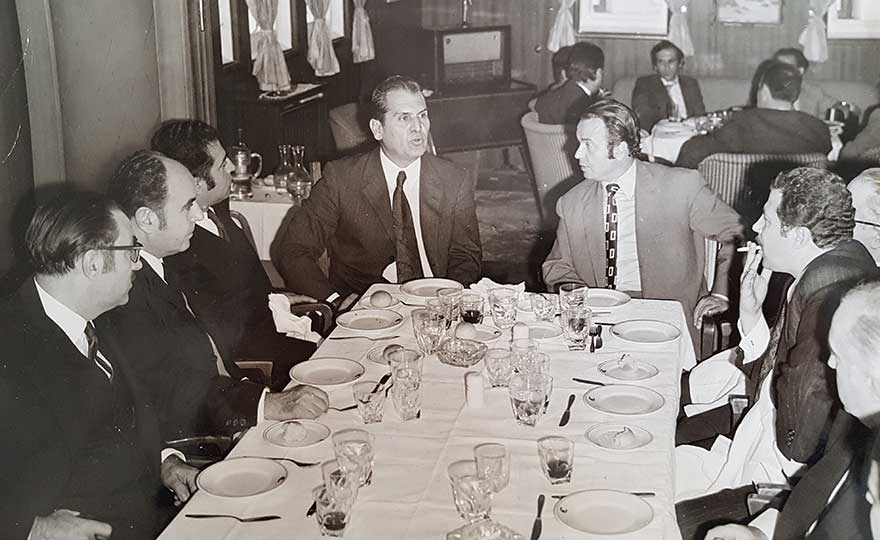
Μία φωτογραφία ντοκουμέντο ἀπό τά ἀρχεῖα τοῦ γράφοντος, πού <τράβηξαν> οἱ ἀδελφοί Ρεντζῆ. Συνέντευξη τύπου τοῦ Κώστα Εὐθυμιάδη πάνω στό ἐπιβατηγό ὀχηματαγωγό "Ἐλεάννα" μέ τήν εὐκαιρία τῶν ἐγκαινίων τοῦ πλοίου στήν γραμμή Ἑλλάδος-Ἰταλίας. Διακρίνονται ἐξ ἀριστερῶν οἱ ναυτιλιακοί συντάκτες Πέτρος Λινάρδος,(ΒΗΜΑ, ΝΕΑ) Ἀνδρέας Μοθωνιός
(ἐκδότης τῆς ΗΜΕΡΗΣΙΑΣ καί πρώην γραμματέας τοῦ <Γέρου τῆς Δημοκρατίας> Γ. Παπανδρέου), Ν. Κολιάτσος, Κώστας Εὐθυμιάδης, Κώστας Δούκας (ΑΚΡΟΠΟΛΙΣ, ΝΑΥΤΙΚΑ ΧΡΟΝΙΚΑ), Σαράντος Σαραντάκος, διευθυντής τότε τῆς ΒΡΑΔΥΝΗΣ τοῦ Τζώρτζη Ἀθανασιάδη πρίν δολοφονηθεῖ, μέ δίπλα του τόν μόλις διακρινόμενο Μανώλη Σίμο, καί Εὐστάθιος Μπάτης (ΑΡΓΩ). Ὁ Εὐθυμιάδης ἐξηγοῦσε στούς ἐκπροσώπους τοῦ τύπου τά μεγαλεπίβολα σχέδιά του νά δημιουργήσει πλωτές γέφυρες στήν Μεσόγειο, γιά νά αὐξήσει τόν τουρισμό καί τήν μεταφορά ἐμπορευμάτων καί εὐπαθῶν γεωργικῶν προϊόντων τῆς Κρήτης.
"Ἂν δέν ἀνοίξουν θαλασσινοί δρόμοι - ἒλεγε - ἡ Ἑλλάδα θά μείνει ὑπανάπτυκτη. Μόνο μέ πλωτές γέφυρες θά φθάσει στήν Ἑλλάδα ὁ εὐρωπαϊκός τουριστικός πλοῦτος καί θά αὐξηθοῦν οἱ ἐξαγωγές καί τά συναλλαγματικά ἀποθέματα τῆς χώρας".
Ἒτσι σκέφτονταν κάποτε οἱ Ἓλληνες πλοιοκτῆτες, ἒστω καί ἂν ἡ τύχη τούς ἒπαιξε ἂσχημα παιχνίδια μέ ἀποτέλεσμα τήν καταστροφή. Πρῶτα ἡ Ἑλλάδα. Σλόγκαν πού λάνσαρε σήμερα ὁ πρόεδρος Τράμπ γιά τήν Ἀμερική. Κάποιοι ἂλλοι ὃμως στηρίχθηκαν σ᾽ αὐτή τήν ἐπιχειρηματική τόλμη καί φαντασία γιά νά δημιουργήσουν τό σύγχρονο ναυτιλιακό θαῦμα.

nafs.gr

06 Σεπτεμβρίου, 2020

Third Cattle Ship Crewmember Is Rescued

...have comment from the very first mom of the accident, in this article, you will find some common reasons that send the seamen to the bottom of the sea, and noone reacts on the almost same reasons causing such accidents. From the other hand, everyone is concerned for the well fair of the seamen. They are hypocrites , they are dangerous. IMO , are you there??/

+++

Cattle Ship Liferaft
A Filipino crew member of Gulf Livestock 1, a cargo ship carrying livestock and dozens of crew that went missing after issuing a distress signal due to Typhoon Maysak, is rescued by Japan Coast Guard crew onboard the vessel Kaimon at the East China Sea, to the west of Amami Oshima island in southwestern Japan, in this still image taken from video September 4, 2020. Courtesy 10th Regional Coast Guard Headquarters – Japan Coast Guard/Handout via REUTERS

by Akiko Okamoto (Reuters) – A third mariner from a ship that capsized this week off Japan with more than 40 crew and a cargo of cattle on board was found alive on Friday after he was spotted by a search plane, Japan’s coastguard said.

The man, 30-year-old Filipino Jay-nel Rosals, was found on a liferaft waving for help 2 km (1.2 miles) off Kodakarajima, a small island in Japan’s southern Kagoshima prefecture, the coastguard said.

He was conscious and was able to walk when the coastguard rescued him. Rescuers also found an overturned orange lifeboat floating at sea some 4 km (2.5 miles) off Kodakarajima, but no one was found on that boat.

Rosals was only the third crew member to be found so far from the Gulf Livestock 1, which capsized in the East China Sea on Wednesday and is believed to have sunk.

The ship, with a crew of 43 crew and a cargo of 6,000 cattle, had sent a distress call amid strong winds and heavy seas whipped up by Typhoon Maysak.

Earlier on Friday it emerged the vessel had a history of mechanical issues.

Rosals’ rescue came hours after another crewman died after being pulled unconscious from the water by the coastguard.

The search is still on for the remaining 40 crew members.

Rescuers have also found a life jacket and cattle carcasses in the area where the ship is believed to have sunk.

Gulf Livestock 1, owned by UAE-based Gulf Navigation, lost engine power before it was hit by a massive wave, according to Chief Officer Sareno Edvarodo, who was rescued on Wednesday. Edvarodo, a 45-year-old Filipino, remains in hospital.

The crew was made up of 39 people from the Philippines, two from New Zealand, and two from Australia, the coastguard said.

The ship is technically managed and crewed by Germany’s Marconsult Schiffarht GMBH, while the commercial manager is Jordan-based Hijazi & Ghosheh Co.

“We are monitoring the situation closely,” a spokesman for Gulf Navigation said in an emailed statement. “Our hearts go out to those onboard and their families at this time.”

The company is working with those involved in rescue efforts and regrets the loss of livestock, he added.

MECHANICAL DEFECTS

Several maritime reports logged over the past two years showed the ship may have had some mechanical defects and revealed operational concerns.

A December inspection report from Indonesian authorities on the website of Equasis, which collates ship safety information from both public and private sources, logged issues with the ship’s propulsion and auxiliary machinery.

The issues included “deficiencies” with the propulsion main engine, gauges and thermometers.

A 2019 report by the Australian government on the cattle ship’s transit in June from Australia to Indonesia noted the vessel’s departure was delayed for a week because of “stability and navigation issues identified by the Australian Maritime Safety Authority”.

Gulf Navigation, Marconsult Schiffarht and Hijazi & Ghosheh Co. did not immediately respond to questions about the reports.

The Japanese coastguard said on Friday it had not set a deadline to end the search for survivors from the ship, which left Napier port in New Zealand on Aug. 14 and had been due to arrive 17 days later at the Port of Jingtang in Tangshan, China.

Four vessels, an airplane and several divers were scouring the waters on Friday when they discovered the second crew member, who has not been publicly identified.

The coastguard said the man died a short time after they pulled him from the sea about 120 km (75 miles) north-northwest of Amami Oshima island and transferred him to hospital.

Melbourne-based Australasian Global Exports confirmed it employed four of the people onboard, with the remaining crew engaged by Gulf Navigation.

“We are in full contact with the families of our four colleagues and are offering them all the support we can,” it said in a statement.

Reporting by Akiko Okamoto and Tetsushi Kajimoto in Tokyo and Roslan Khasawneh in Singapore; Writing by Jane Wardell and David Dolan; Editing by Lincoln Feast, Himani Sarkar and Frances Kerry

gcaptain.com

I am praying’: Cattle Ship Captain’s Texts As Typhoon Builds

 by 

Cattle Ship Chief Engineer
Aristotle Sabillena, Chief Engineer of the Gulf Stock I. Media handout via Reuters

by Martin Petty (Reuters) – The last time Marielle June Chunanon heard from her partner Dante Addug aboard the storm-struck Gulf Livestock 1, he told her he was frightened, and praying for typhoon Maysak to pass.

That message exchange between the Filipino couple was on Tuesday night, as a ferocious storm in the East China Sea battered the 130-metre (450-foot) ship, its 43 crew and nearly 6,000 cattle.

Addug, 34, the ship’s captain, sent hours of instant messages to the mother of his four children, typing frantically, telling her the typhoon had intensified and water had caused the engine to fail.

“The typhoon is so strong up to now. Here I am praying for the typhoon to stop,” Chunanon, 35, said by phone, recalling his message.

The ship capsized en-route from New Zealand to China and the search is still on for 40 crew members, Addug among them.

Two Filipino crew have been rescued so far, one on Wednesday and another on Friday, found on a life-raft. An unidentified man pulled unconscious from the water on Friday later died.

Chunanon learned the ship was missing from a Facebook post by the wife of a crewman.

“My body was trembling that time,” she said. “Even if they lose internet connection, he finds a way to message me.”

“I’m getting nervous while the time is running out,” she said.

Addug boarded the Gulf Livestock 1 in November 2019 and was due home next month to be reunited with his family and meet his 4-month-old son for the first time.

“When I kept asking them to pray with me, they asked why, then they saw me crying,” she said.

Chunanon said her eldest daughter, 6, saw her watching news about the ship and asked if her father was missing.

“Last night she asked ‘has daddy been saved?’”

‘THEY’RE ALIVE SOMEWHERE’

Liberty Seneres, wife of chief engineer, Aristotle Sabillena, said she received pictures of her husband’s cabin with items strewn across the floor, shortly before losing contact.

She urged the coastguard not to give up.

“I am praying he is still safe somewhere,” she said. “I asked the lord to give me a sign.”

“Keep searching for them. They’re alive somewhere.”

Captain Addug had earlier sent messages to his partner complaining of a headache and dizziness from powerful waves.

He sent maps of the ship’s location in relation to the typhoon.

A few hours later, Chunanon saw his photos of the storm intensifying.

“I’m so worried, hopefully the typhoon will weaken,” she wrote.

“It is frightening,” he replied.

Soon after, he returned to the ship’s command, leaving his phone behind.

Her last message went unanswered.

“Hello my love, I’ll sleep now. How are you there? I hope and pray you are safe,” she wrote.

Writing by Martin Petty, Reuters

gcaptain.com

What Are The Most Dangerous Waters in the World Today?

...it is always the same waters that ignorants from the deep Mongolia, think that they can cross without harm. Hoping that the world is not so stupid as before.... perhaps more????? 


FILE PHOTO: Russian Navy’s reconnaissance ship Liman of the Black Sea fleet sails in the Bosphorus, on its way to the Mediterranean Sea, in Istanbul, Turkey, November 18, 2015. REUTERS/Yoruk Isik/File Photo

By Admiral James Stavridis (Bloomberg) As a Greek-American who lived in Athens for three years, and as a U.S. Navy mariner, I got to know the eastern Mediterranean well. It has been a strategic crossroads throughout history for Greeks, Persians, Egyptians, Jews, Phoenicians, Romans, Crusaders and more modern sea warriors.

Whenever I’ve sailed the waters, during the Cold War and afterward, there has been intense disagreement about maritime boundaries, conflicting claims for natural resources, and other geopolitical pressures stemming from the unstable relations among Greece, Turkey, Israel, Cyprus and Syria.

Unfortunately, I’ve never seen things more volatile in the eastern Mediterranean than right now — even in periods when Israel has been in combat against its neighbors ashore. What are the factors driving this tension, and what is the role of the U.S.?

First, the current turbulence stems largely from the discovery of large deposits of oil and natural gas in the seabed. Estimates put the size of the deposits at around 2 billion barrels of oil and 4 trillion cubic meters of natural gas, and the nations of the region naturally are moving aggressively to exploit the wealth. In January 2019, a loose consortium to develop the resources was forged, consisting of Israel, Egypt, Italy, Greece, Jordan and the Palestinian territories — but not Turkey.

The Turks were understandably incensed, and have dispatched oil exploration vessels and drilling ships escorted by Turkish Navy warships. One, the exploration ship Oruc Reis, entered what Greece considers its territorial waters this summer, putting tensions at a new high. Turkey’s actions have earned the condemnation of the European Union.

Second, the eastern Mediterranean is also the transit zone for Turkish and Russian warships sending arms to opposing sides in the Libyan civil war. Turkey is supporting the United Nations-recognized government in the capital of Tripoli, while Russia (along with Egypt, the United Arab Emirates and other Arab nations) is supporting the rebel forces of General Khalifa Haftar.

The EU is trying to enforce an arms embargo on the Libyan conflict (much as I did while commanding North Atlantic Treaty Organization forces during the 2011 civil war). In June, this resulted in a confrontation between French and Turkish warships, which illuminated each other with their fire-control radars, the final step before firing a missile. NATO allies coming this close to a major military incident is unheard of.

President Emmanuel Macron of France, which supports the claims of Greece and Cyprus, calls stopping Turkey’s aggressive actions a “red-line” issue. “When it comes to Mediterranean sovereignty, I have to be consistent in deeds and words,” he told reporters last week. “I can tell you that the Turks only consider and respect that.”

The third point of contention is between Greece and Turkey over Aegean territorial disagreements. Greek Prime Minister Kyriakos Mitsotakis recently proposed extending his nation’s territorial sea claims over its islands on the western, Italian side of Greece from 6 nautical miles to 12. The Turks have warned that if Greece tried extending its claims similarly eastward, in the Aegean Sea toward Turkey, it would be cause to go to war.

Turkey’s defense minister, Hulusi Akar, has called for talks. I know Akar well from NATO days, and he is a thoughtful, sensible leader who will do what he can to make peace. But there doesn’t seem to be much appetite for negotiation right now.

The entire scenario in the eastern Mediterranean is playing to Russia’s advantage. Above all, it is causing serious rifts in the NATO alliance. The Turks and Greeks have never gotten along, but rarely have things been this heated, and France lining up strongly behind the latter is a new twist. The Germans are trying to mediate, with little success.

As Turkey feels pushed away from both NATO and the EU, it strengthens the tendency of President Recep Tayyip Erdogan to work with Russia (notwithstanding their disagreement over the sides in Libya). As Turkey feels more estranged from the alliance, it may be more inclined to purchase advanced weapons from Moscow — as it already has with Russia’s advanced S400 missile system.

All of this is exacerbated by a sense in Europe and the Middle East that the U.S. is trying to disengage from the wider area. Washington’s recent announcement that it plans to pull troops out of Iraq fueled this impression, as have the Trump administration’s comments about leaving Syria and Afghanistan.

Instead of ducking out, the U.S. should try to act as a mediator between Turkey and the Greece-France-Cyprus trio. Secretary of State Mike Pompeo made a start on Wednesday, saying, “We’re urging everyone to stand down to reduce tensions and begin to have diplomatic discussions.”

Washington should also seek a solution to the S400 problem (perhaps with a technical fix “blocking off” the Russian system from interoperating with the rest of NATO air defenses) and work behind the scenes with Turkey to resolve the lingering issues on the island of Cyprus, which is partly controlled by Turkish troops.

An incident at sea in which NATO warships end up actually shooting at each other seems an unimaginably bad outcome, but unfortunately isn’t out of the realm of possibility. The eastern Mediterranean, which has seen more than its share of combat over the centuries, is replacing the South China Sea and the Arabian Gulf as the world’s preeminent maritime hot spot.

gcaptain.com


03 Σεπτεμβρίου, 2020

Livestock Carrier with 43 Crew Goes Missing Off Japan -

usually, everyone related with sea, have already start looking to find the mistakes, or the wrong doing after a tragedy. 

This story of the big ships carrying livestock must stop, NOW. 

The any accusations would be directed, to the flag state, to surveyors and ship's classification   who have agreed to such modification, that they did not stop it for further repairs, as often this ship was stopping in the seas out of command due to engine problems. 

The matter of speed is essential, and there is no way a livestock in such voyages to sail with 8 knots. It is 101% unacceptable.

It might looks strange that only one has survived from this tragedy, and that one,  seems that, he has not to say much.... It is not difficult to imagine what happenned upto that time of capsize. I hope God to brings them up, at least to be delivered to their families.

Same happened in Med sea, years back, off Tartous Syria. I was amazed of that ship, which was not a cargo ship modification, but straight from the yard. 50 crew in total was on board, and they dissapear in one hour, after the Captain decided to move in a distance from the shore, due to coming bad weather.

For months, cud not forget what happened, it was easy to find out what was the cause, but the most strange is that all authorities, agreed to the reasons of that capasize, leaving 50 seamen dead.

So the strange thing is that as we see today, seems that classification society'w have not change the criteria at all, in order to not happen again the same.

They are dangersously ignorants, and someone has to stop them.

The death toll of seamen , because of wrong doing has to be halted now.

Today the weather in Japan was better, still nothing found, as the ship capsized and sank, in short time. Still we hope.

+++


MV Gulf Livestock 1. File Photo: MarineTraffic.com/bruce colyer

The Japanese Coast Guard is searching for a livestock carrier with 43 crew members on board after a distress signal was sent from the vessel on Wednesday.

Reports say the Gulf Livestock 1 issued a distress signal at around 1:20 a.m. local time Wednesday while around 115 miles west of Amami Oshima Island in southwestern Japan.

The ship is reported to be carrying 43 crew members.

The search is being conducted in the general vicinity of Typhoon Maysak, which was last reported to be packing 130 mph winds, equivalent to a Category 4 hurricane.

The Gulf Livestock 1 was reportedly transporting cattle from Napier, New Zealand to Tangshan, China. The vessel was built in 2002 and registered in Panama. It is owned by Dubai-based Gulf Navigation.

In late July, the Philippine Navy rendered assistance to the Gulf Livestock 1 after it lost propulsion off Balut Island in Southern Philippines. Repairs were eventually completed without incident.

g captain.com