On a laid-up mobile offshore drilling unit (MODU), a worker descended alone into the leg to check on a diesel pump being used for dewatering operations. When he didn’t return, an electrician went down and found him collapsed near the pump. The electrician was nearly overcome by exhaust fumes but made it back on deck and raised the alarm.
Another crew member immediately descended to help. Then the captain, superintendent, and a fitter entered the leg to attempt a rescue. They found the second crew member, who had collapsed one level above the first worker. Without proper safety equipment, however, they too began to suffer the effects of the vapor in the confined space. By the time a sixth crew member, the rigging master, entered the leg outfitted with a breathing apparatus, the fitter had collapsed. The rigging master managed to help the captain and superintendent escape, but it was too late for the first three crew members who had entered the leg.
They lost their lives in what the U.S. Coast Guard later described as a preventable tragedy marked by a lack of training and the absence of safety gear.
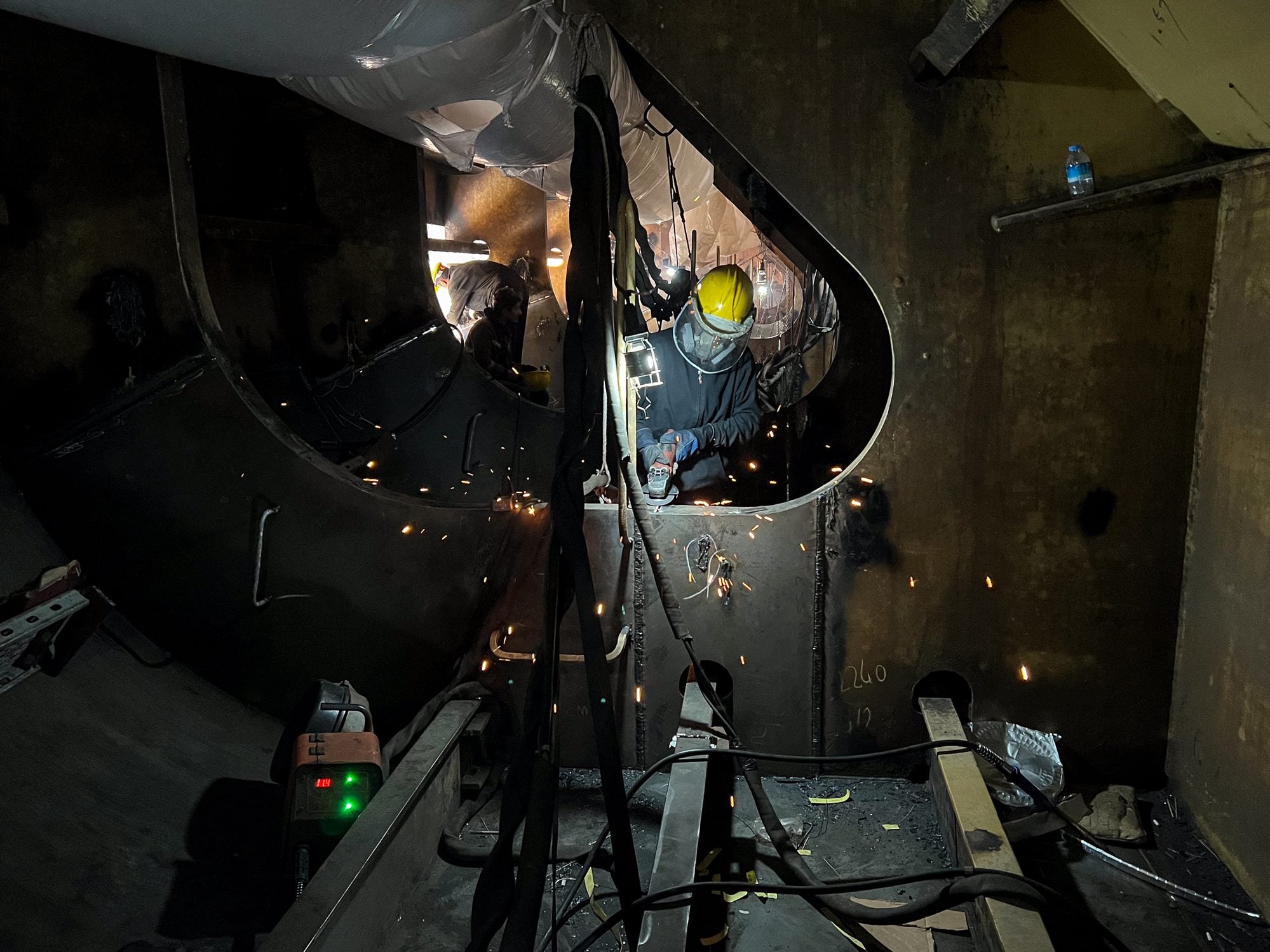
This was not an isolated occurrence. According to data from the U.S. Bureau of Labor Statistics, more than 100 workers die in confined space accidents each year. In the maritime industry, these incidents may occur in cargo holds, ballast tanks, fuel tanks, pump rooms, and engine compartments, which exist on every vessel and platform.
What Makes a Space “Confined”?
Confined spaces are unavoidable in maritime operations. They’re also among the deadliest work environments in the industry.
OSHA defines a confined space as an area that meets three specific criteria:
- It is large enough for a worker to enter and perform tasks.
- It has limited or restricted entry and exit points.
- It is not designed for continuous occupancy.
In maritime settings, confined spaces are everywhere:
- Cargo holds and hold access areas
- Ballast tanks and double-bottom tanks
- Fuel and oil tanks
- Pump rooms and engine spaces
- Cofferdams
- Void spaces
- Chain lockers
- Duct keels
On offshore platforms, confined spaces include:
- Storage tanks and vessels
- Mud rooms
- Equipment housings
- Subsea chambers
- Process vessels
- Pipe galleries
A space becomes a “permit-required confined space” when it contains or has the potential to contain a hazardous atmosphere, materials that could engulf an entrant, walls that converge inward or floors that slope downward and taper into smaller areas, or any other recognized safety or health hazard.
Why Confined Spaces Are So Dangerous
Confined spaces are dangerous because they are not meant for human occupancy. The very characteristics that define them (limited access, restricted airflow, and tight quarters) create conditions that can turn deadly in moments.
Oxygen Deficiency
Asphyxiation is the leading cause of death in confined spaces across all industries. For worker safety, oxygen levels should remain between 19.5 and 23.5%. In confined spaces, oxygen can drop lower due to rusting (which consumes oxygen from the air), lack of airflow, or displacement by other gases.
According to a study by the International Group of Protection & Indemnity Clubs examining fatalities from 2015 through 2020, 53% of the 83 deaths in enclosed compartments resulted from oxygen depletion. The danger is invisible and often odorless. Workers may not even realize anything is wrong until they begin to lose consciousness.
Toxic Atmospheres
In a confined space, poor ventilation allows toxic fumes to accumulate.
In maritime settings, this can include:
- Hydrogen sulfide from decaying organic matter or stagnant seawater
- Carbon monoxide from engine exhaust or combustion
- Hydrocarbon vapors from fuel and cargo residues
- Paint fumes and solvent vapors
- Welding fumes and metalworking emissions
Even seemingly harmless cargo can generate lethal gases in enclosed spaces. In 2022, two technicians lost their lives after entering a cargo tank on a vessel that had recently held soybean oil. Both were overcome by hydrogen sulfide.
Flammable Atmospheres
When flammable vapors reach 10% or more of the Lower Explosive Limit (LEL), the atmosphere becomes hazardous. Even concentrations below 10% can indicate vapors are being released into the space and could present a hazard over time. A single spark is all it takes for a flammable atmosphere to ignite, causing an explosion that not only endangers workers inside the confined space but also any in the general vicinity of the blast.
Physical Hazards
Beyond atmospheric dangers, confined spaces present multiple physical risks:
- Limited escape routes that become blocked or impassable
- Inadequate lighting
- Unguarded machinery
- Exposed electrical equipment
- Temperature extremes
- Slick or uneven surfaces
- Ladders and vertical access points that fail or become hazardous
When Rescue Becomes the Next Tragedy
Approximately 60% of confined space fatalities involve would-be rescuers. This pattern repeats itself in incident after incident. A worker enters a confined space and collapses. A colleague sees them down and rushes in to help, without a breathing apparatus, without testing the atmosphere, and without following any rescue protocol. That rescuer collapses. Sometimes a third person enters. The death toll climbs.
That is precisely what happened on the MODU discussed at the beginning of this article. Two crew members lost their lives attempting to save the first worker who had entered the confined space. The emotional (and very human) reaction of would-be rescuers makes confined space emergencies uniquely dangerous. Seeing a co-worker in distress triggers an instinct to help immediately. But in a confined space with a hazardous atmosphere, an untrained, unequipped rescuer has little chance of success and a high likelihood of becoming another victim.
Rescue from confined spaces requires:
- Specialized breathing apparatus
- Retrieval equipment and harnesses
- Continuous atmospheric monitoring
- Trained rescue personnel
- Communication systems
- Medical support ready at the entry point
The remoteness of offshore platforms compounds these challenges. Emergency response teams may be hours away. The “golden hour” for medical treatment becomes impossible to achieve. Every second counts, yet proper rescue protocols require time and equipment that may not be immediately available.
A Pattern of Preventable Deaths
In June 2022, three stevedores lost their lives in a confined space incident aboard a bulk carrier in Indonesia. The incident unfolded during coal loading operations, when a stevedore unintentionally entered the access space of a cargo hold instead of a different cargo hold that contained a bulldozer. The access space had oxygen levels of just 0.9%, far below the minimum threshold of 19.5%. The stevedore collapsed and was found at the bottom of a ladder, unconscious, 26 minutes later.
As the bulk carrier’s crew went to fetch rescue equipment, two other stevedores entered the confined space—without proper safety equipment—in an attempt to rescue their co-worker. Both succumbed to the noxious atmosphere.
An investigation into the matter by the UK’s Marine Accident Investigation Branch (MAIB) revealed key safety issues. Not only were the stevedores lacking training on the dangers of enclosed spaces (and safe rescue methods), but the access hatches to the cargo spaces were unlocked even though they weren’t in use.
A survey of enclosed space accidents by InterManager revealed:
- The highest percentage of incidents occurred on bulk carriers (41%) and tankers (23%), with the most frequent locations being cargo holds and hold access areas (51%). Cargo oil tanks presented a significant risk (18%).
- The majority of fatalities involved senior ranks, with masters, chief engineers, chief officers, and second engineers accounting for 66% of casualties. Cadets and trainees represented just 6%.
The risks of confined spaces on offshore platforms, rigs, and maritime vessels are well known and documented. And yet, workers continue to suffer the consequences of their employers’ failures to mitigate these risks.
OSHA Confined Space Standards in the Maritime Industry
Confined space work in the maritime industry is governed by specific OSHA regulations that differ from general industry standards. The key regulation is 29 CFR Part 1915, Subpart B: Confined and Enclosed Spaces and Other Dangerous Atmospheres in Shipyard Employment.
Unlike general industry requirements, maritime regulations do not require a traditional “permit entry” system. Instead, they mandate the use of specifically qualified individuals and a system containing evaluation mechanisms, tracking criteria, and control measures.
The order of atmospheric testing when determining hazards must be:
- Oxygen content
- Flammability
- Toxicity
This sequence is critical because oxygen deficiency can cause immediate unconsciousness, whereas flammability may only impact hot work. It also serves to establish designations like “Not Safe for Workers” or, in confined spaces with sufficient oxygen levels, “Not Safe for Workers – Not Safe for Hot Work.”
Before entry into a confined space, the following is required:
- Atmospheric testing by qualified personnel
- Certification that the space is “Safe for Workers” or “Safe for Hot Work”
- Continuous forced ventilation when required
- Multiple means of access where work may generate hazardous atmospheres
- Posted entry restrictions and warnings
During work in a confined space, the following must occur:
- Continuous or periodic monitoring of atmospheric conditions
- Maintenance of certification conditions
- Immediate work stoppage if conditions change
- Visual inspections and re-testing when changes occur
Hot work (welding, burning, cutting, or grinding) in or adjacent to spaces that contain or have contained combustible or flammable liquid or gases requires testing and certification by a Marine Chemist or U.S. Coast Guard authorized person. The certificate must be posted at the site and kept on file for three months after the completion of work for which it was issued.
IMO Confined Space Regulations
The International Maritime Organization (IMO) addressed confined space safety in 2011, through Resolution A. 1050(27): Recommendations for Entering Enclosed Spaces Aboard Ships. In June 2025, the Maritime Safety Committee adopted Resolution MSC.581(110), establishing revised and more stringent recommendations for entering enclosed spaces.
Key requirements:
- Every vessel must maintain a unique register of its enclosed spaces, their hazards, and how conditions may change based on cargo.
- Competent and responsible persons must receive comprehensive training in hazard recognition and atmospheric testing.
- Single-person entry into enclosed spaces is prohibited.
- Entry operations must occur during normal working hours with adequate time allocated.
- Atmospheric testing must check for oxygen, flammability, toxicity, and carbon dioxide.
- Ships must maintain emergency response plans that are regularly practiced and followed to the letter.
What Needs to Change
Seamen, offshore workers, stevedores, and other employees in the maritime industry must be equipped with the training and equipment to properly navigate enclosed spaces.
Employers must:
- Identify and evaluate all confined spaces on vessels and platforms
- Test atmospheres before every entry using properly calibrated equipment
- Provide continuous ventilation when required
- Maintain and inspect ladders, access equipment, and rescue gear
- Supply appropriate PPE, including breathing apparatus and gas detection equipment
- Train all personnel in confined space hazards, entry procedures, and emergency response
- Use buddy systems with continuous communication
- Establish dedicated rescue teams with proper equipment and training
- Never allow time pressure to override safety procedures
- Create a culture where workers feel empowered to refuse unsafe entry
The question is not what needs to be done. The procedures exist. The question is why those procedures continue to be ignored or inadequately implemented, and what systemic changes will finally make confined space work as safe as regulations intend it to be.
Arnold & Itkin is a Houston-based trial law firm founded in 2004 by Kurt Arnold and Jason Itkin. The firm focuses on maritime law, offshore injuries, industrial accidents, and complex personal injury cases. With a track record that includes over $25 billion in verdicts and settlements, including some of the largest jury awards in U.S. history, Arnold & Itkin represents workers injured in vessel and platform accidents, including confined space incidents. The firm’s attorneys have deep experience navigating OSHA regulations, maritime law, and the unique challenges faced by offshore and maritime workers.